Ronald Kolb
Post-Exhibitionary Practice
Art as Ecological Practice
2025–2026
M.1 Arthur Boskamp-Stiftung
https://www.m1-hohenlockstedt.de/en/kuratieren/m1-kuratieren-202526/
A process-based exhibitionary project exploring ecological practice through workshops, performances, screenings, installations, cooking and structured around artistic research, collaborative activities, and four seasonal assemblies
Participating Artists & Researchers
Artists and researchers include Camilla Berner, Ewen Chardronnet, Field Narratives (Sascia Bailer, Andreas Doepke, hn. lyonga, Lene Markusen), Taro Furukata, Fernando Garcia-Dory (INLAND), Frauke Gerstenberg & Leon Bischinger (Muthesius Kunsthochschule Kiel), Seraina Grupp, Maj Hasager (Malmö Art Academy, Lund University), Emilio Hernández Martínez (Cocina CoLaboratorio) & Dea López (Co.merr), Michael Hiltbrunner, Christian Huck, James Jack, Astrid S. Klein, Lene Markusen, Maya Minder, Meika Mizuno, Eva Hertzsch & Adam Page, Åsa Sonjasdotter, Riikka Tauriainen, Byungseo Yoo, Daniela Zambrano Almidón, and more.
With local experts Wiebke Habbe, Erika Harzer, Raphaela Kuhn & Basti Weber, Inke Magens, Marle Rudolph and others.
Curated by
Ronald Kolb (Artistic Director, M.1 Arthur Boskamp-Stiftung)
Kindly supported by
Swiss Arts Council Pro Helvetia, Ville de Geneve, Bingo! Projektförderung Schlewsig-Holstein, Kulturprojekte Schlewsig-Holstein, Kunstförderung Kultur Land Schlewsig-Holstein
Abstract
The project seeks to get to the bottom of these questions:
How can contemporary artistic practices and their exhibitionary formats
contribute to a sustainable way of life?
How can cultural practices help to translate evidence-based knowledge
into common knowledge?
Art as Ecological Practice aims to implement ecological thinking in artistic and collaborative practices. To do this, we may have to leave the symbolic distance of art. The project aims to go beyond aesthetic representations of “nature” and broaden awareness of the climate crisis. It aims to put ecological thinking into action through artistic, scientific and economic collaboration and coordination.
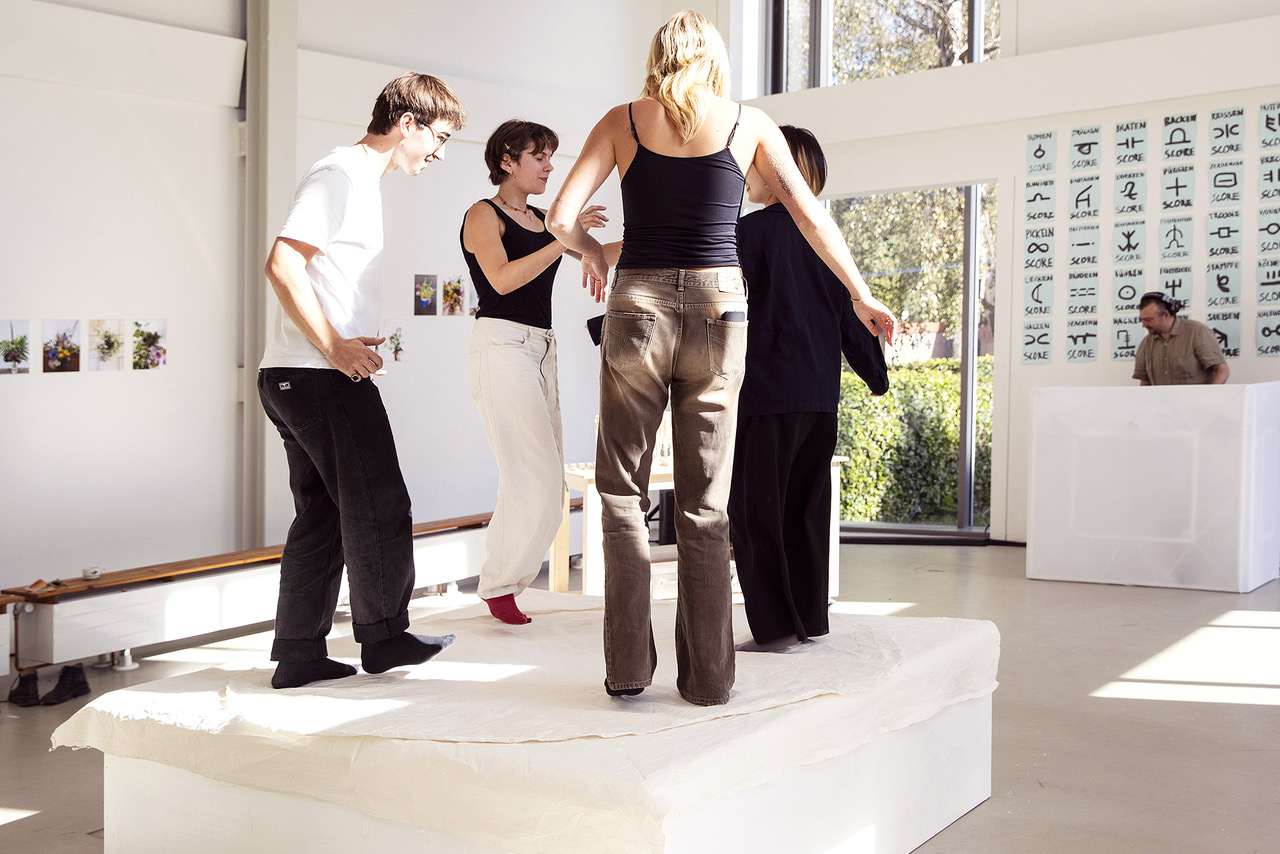
The year-long exhibition project Art as Ecological Practice (M.1, Arthur Boskamp-Stiftung, 2025–2026) unfolds in four public seasonal festivals – assemblies –, and establishes a process-oriented artistic program dedicated to ecological thinking, sustainability, and collective practices of doing. The temporary assemblages brought together artists, researchers, and practitioners from Peru, South Korea, Japan, Germany, Switzerland, Denmark, and Sweden, participants (local and international), artworks, the surrounding landscape with its agroecological practices, and more-than-human presences — forming taskspace formations: temporal acts of doing-together with the aim to explore how artistic and curatorial formats can contribute to sustainable ways of living and to the transference of ecological and scientific knowledge into public discourse.
The program emphasized the performative, relational, and participatory dimensions of art practices and highlighted contributions in the field of art-science collaborations, environmental ethics, and ecological artistic research. The involved artists contributed with artistic research, workshops, performances, installations and lectures, that merged artistic experimentation with ecological inquiry.