Ronald Kolb
Post-Exhibitionary Practice
Curating as Governmental Practices. Post-Exhibitionary Practices under Translocal Conditions in Governmental Constellations
May 2024
Author
ISBN 978-3-9524078-2-0
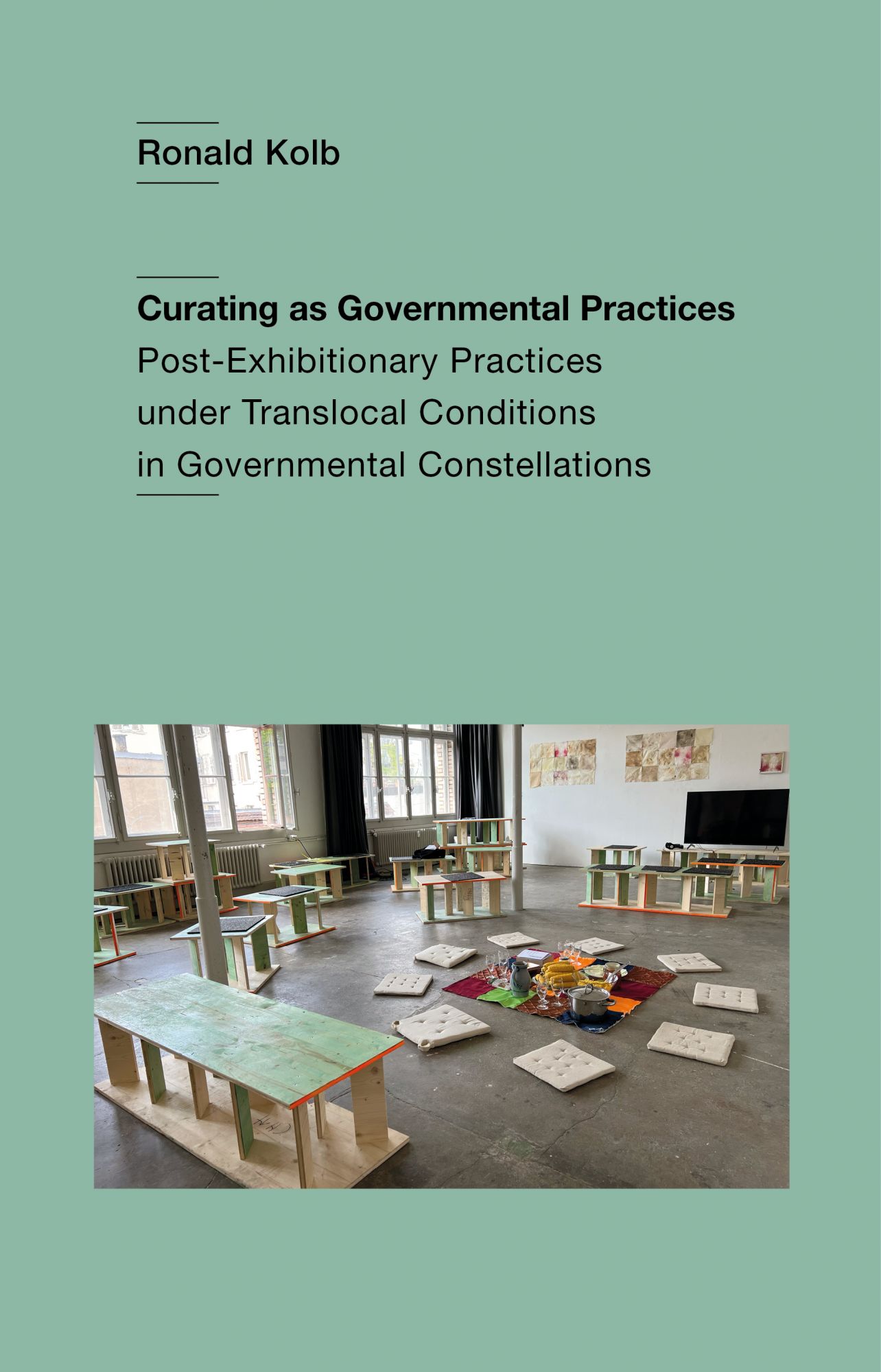
Published dissertation
OnCurating, May 2024
ISBN 978-3-9524078-2-0
309 pp.
This study focuses on the understanding of art as governmental practices. It researches global and postcolonial – translocal & transcultural – contexts of contemporary artistic and curatorial practices, theoretically and through an in-depth analysis of two case studies: Philadelphia Assembled demonstrates the complicated power dynamics within collaborative artistic practices, while documenta fifteen highlights the many complex challenges that the commons approach, and thus more horizontal forms of knowledge production, bring to the art field.
Reassessing the curatorial discourse of the “New Museology” since the 1990s (Bennett et al.) and incorporating feminist-influenced critiques of representation (Spivak, Haraway) and the concept of governmentality (Foucault), this dissertation introduces the concept of the “post-exhibitionary complex.” Here, exhibitions become active social spaces and contact zones that promote participatory aesthetic formations that stay with (self)critical theory practices. This approach promotes nuanced, networked forms of knowledge production and dissemination grounded in feminist materialism (“Situated Knowledges”).
An analytical toolkit is introduced as a non-comprehensive manual to evaluate exhibitionary projects and their institutional frameworks, focusing on the relationships between art, institutions, and audiences in their governmental and economic contexts.
Overall, the study aims to offer an in-depth analysis of the changing landscape of art and curatorial practices in response to global political and economic shifts, highlighting the importance of transversal and post-exhibitionary approaches.